Review Policy
1. Editorial and Peer Review Process
The journal applies a double-anonymous peer review model in accordance with international scholarly publishing standards.
All submissions are handled through the journal’s online system, which enables authors to monitor the progress of their manuscripts throughout the review process.
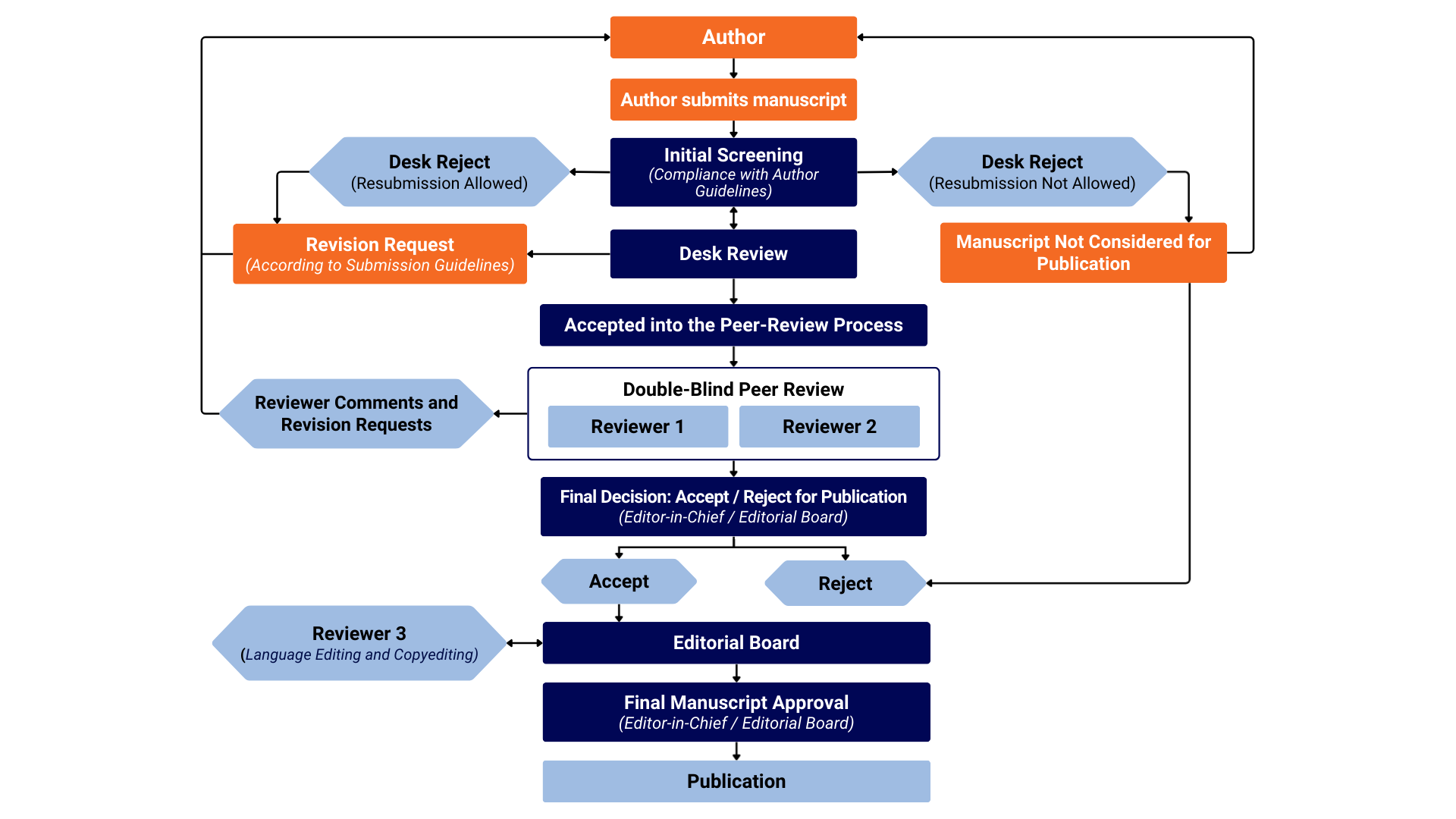
The editorial and peer review process of JTD consists of 03 main stages:
- Stage 1 – Initial screening
- Stage 2 – Peer review
- Stage 3 – Final decision
Initial Screening:
Following submission, manuscripts are subject to an initial editorial assessment. Upon submission, authors will receive an automated confirmation. All manuscripts undergo two mandatory checks:
- Research integrity check, including:
- Plagiarism and text overlap;
- Use of artificial intelligence (AI);
- Duplicate or redundant publication.
- Compliance with the journal’s Author Guidelines, formatting requirements and the academic standards for manuscripts in the fields of technology, engineering, and design.
Outcomes: Manuscripts that do not meet these requirements may be rejected or returned to the authors for revision. Manuscripts that pass the initial screening proceed to peer review.
Processing time: up to 5 working days.
Peer Review:
At least two independent reviewers are assigned by the Editorial Board. Manuscripts are evaluated based on the following criteria:
- Structure, presentation, and clarity of the manuscript;
- Theoretical foundation, conceptual framework, or technical basis;
- Research, design, or technical methodology;
- Validity and reliability of data, models, experiments, or evaluation;
- Scientific contribution and practical relevance to the fields of Technology, Design, and Innovation.
Review outcomes:
- Accept;
- Revision (Major/Minor);
- Reject.
Review period: 1–21 days;
Author revision: 1–10 days;
Total duration: approximately 1–3 months.
Final Decision:
The Editor-in-Chief is responsible for making the final decision on all manuscripts, based on:
- Reviewers’ reports;
- the quality and completeness of the manuscript;
- The scope and priorities of the journal.
In cases of conflicting reviews, additional reviewers may be consulted.
The time to final decision may take up to 9 months from the commencement of peer review.
2. Peer Review System
The journal adopts a double-blind peer review process, in which the identities of both authors and reviewers are kept confidential.
Each submitted manuscript is evaluated by at least two independent reviewers.
Reviewer Selection Criteria:
- Demonstrated expertise in the relevant field of study;
- No conflict of interest with the authors or the manuscript;
- A proven track record of academic publishing within the last five years;
- Not a recent collaborator or co-author of the submitting authors.
Review Process:
- Initial editorial screening – approximately 1 week
- Dispatch to 2 reviewers – 1 week
- Peer review period – typically 3–4 weeks
- Editorial decision – 1 week
- Author response – 2-4 weeks
- Second round of review (if required) – typically 2–3 weeks
Average Timeline:
- From submission to first decision: approximately 6–8 weeks
- From submission to publication (if accepted): approximately 1–2 months after acceptance
3. Editorial Decision Types
- Accept (A): The manuscript meets all publication criteria and is accepted without further revisions.
- Accept with Minor Revision (AMR): The manuscript requires minor revisions before it can be accepted for publication.
- Revise and Resubmit (R&R): Major revisions are required before the manuscript can be reconsidered.
- Desk Reject (DR): The manuscript is out of scope or does not meet the minimum quality standards.
- Reject (R): The manuscript does not meet the journal’s quality criteria.
4. Conflict of Interest
All authors, reviewers, and editors must disclose any conflicts of interest that could influence their work, including but not limited to:
- Financial relationships
- Personal or professional relationships
- Intellectual property interests
- Interests in related companies or organizations